Play Therapy in Springfield, MO
Play is how children make sense of the world. In play therapy, it becomes a way to heal.
Our clinicians offer play therapy to children, teens, and adults across southwest Missouri and the Springfield, Missouri community, because some things are easier to show than to say.
- Children, teens, and adults
- Sandtray available
- Rooted in nervous system regulation
What is play therapy?
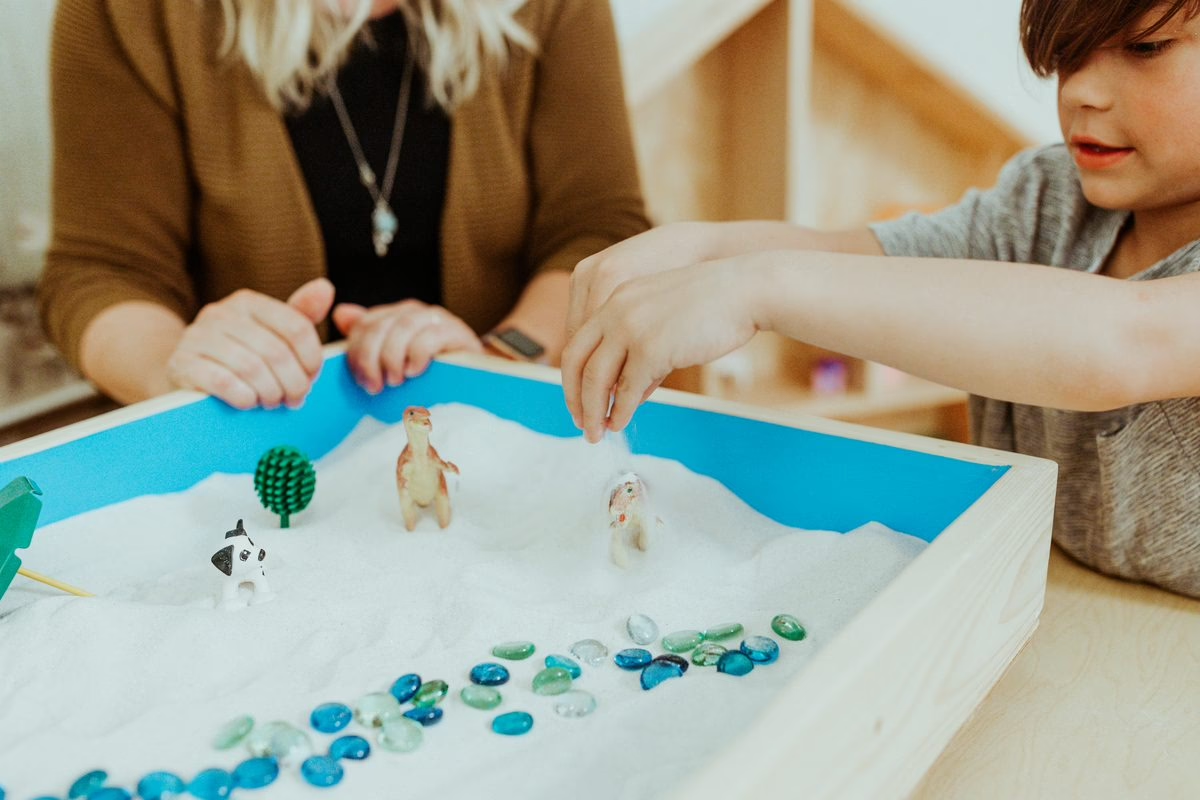
Children do not usually have the words for what they are carrying. They show it instead, in how they play. A play therapy room gives them toys, art materials, sand, and small figures, along with a therapist who pays close attention and stays steady with whatever comes up.
Through play, a child can work through fear, anger, grief, or confusion at a safe distance, try out new endings, and experience what it feels like to be understood. The relationship with the therapist is at the center of the work.
Play is not only for children. Teens and adults can use play, art, and sandtray to reach what is hard to put into words.
Synergetic Play Therapy and interpersonal neurobiology
Our play therapy is closest to Synergetic Play Therapy, a model developed by Lisa Dion in 2008. It blends the therapeutic power of play with principles from nervous system regulation, interpersonal neurobiology, attachment theory, mindfulness, and the authenticity of the therapist. It includes both child-led and therapist-guided moments.
Interpersonal neurobiology, often called IPNB, looks at how relationships shape the developing brain and nervous system. In practice, this means your child’s therapist is not only watching the play. They are helping your child’s nervous system learn, in the moment, that big feelings can be felt and survived with someone steady nearby.
This fits naturally with Somatic Integration and Processing, Beyond Healing’s own attachment-informed and nervous system-informed model, and with the EMDR therapy we offer to children. Learn about somatic-informed therapy
Who play therapy can help
Play as a first language
For younger children, play is the main way the work happens. Parents and caregivers are part of the process, and your child’s therapist will talk with you about how you will be involved.
Room to create
Teens often use more structured activities, art, and sandtray, which can feel easier than sitting face to face and talking.
Reaching past words
Adults can use play and sandtray to approach experiences that are hard to describe, especially ones from early in life.
Building a world in the sand
You choose small figures and arrange them in a tray of sand to build a scene. The scene often says something that words have not been able to, and you and your therapist explore it together.
Our play therapists
Erin Conley, LPC, a Certified Play Therapist, leads our play therapy work. Kate Young, LPC, and Ashley Wallace, LPC, also offer play therapy.
When a child’s struggles involve the whole household, play therapy can sit alongside family therapy.
What the research says
Here is what studies of play therapy, sandtray, and the nervous system science behind our approach have found, including what they cannot tell us yet. Every item below is free to read.
Play therapy eased behavior problems
A 2021 meta-analysis combined 23 studies of 908 children, ages 2 to 12, referred for disruptive behavior. Child-centered play therapy led to moderate improvements in overall behavior problems compared with no treatment, and in acting-out behavior compared with other treatments.
Worth knowing: study quality varied, and few studies compared play therapy with another active treatment.
M. M. Parker, K. M. Hunnicutt Hollenbaugh, and C. T. Kelly, 2021, International Journal of Play Therapy
Sandplay helped children and adults
A 2019 review found 16 randomized trials and 17 other studies of sandplay therapy. Across them, children and adults showed meaningful improvement in problems including anxiety, depression, behavior difficulties, and post-traumatic stress. The author notes sandplay may be especially useful when trauma or language makes talking hard.
Worth knowing: most studies were small and many did not report effect sizes.
C. Roesler, 2019, The Arts in Psychotherapy
Moving toward regulation
This article describes Synergetic Play Therapy combined with child-centered play therapy and follows two children through treatment. In both cases, the behaviors that brought them in became less severe.
Worth knowing: these are two case studies, not a trial. The author calls for more research on the approach.
J. Simmons, 2020, Canadian Journal of Counselling and Psychotherapy
Feeling safe is a body state
Polyvagal theory, one of the ideas Synergetic Play Therapy draws on, proposes that feelings of safety come from states of the nervous system, shaped by cues from the people around us. It is one reason our therapists pay attention to how steady they are in the room.
Worth knowing: this is a theory paper by its author. Polyvagal theory is influential in therapy, and some of its physiological claims are debated by other researchers.
S. W. Porges, 2022, Frontiers in Integrative Neuroscience
Cost and insurance
Most of our counselors operate on a self-pay basis, with rates that vary by provider level. A small number of our clinicians are in-network with Cox HealthPlans, and we can provide a superbill for out-of-network reimbursement. Insurance and payment information
Other ways we can help
Play therapy is one part of counseling at Beyond Healing. If your child or teen may also need medication support, Beyond Healing Psychiatry offers psychiatric evaluation and medication management. Call (417) 641-2406.
Frequently asked questions
What ages do you see for play therapy?
We offer play therapy to children, teens, and adults. The way we use play changes with age.
What if my child does not want to talk?
That is one of the reasons play therapy exists. Children often show through play what they cannot yet say.
Will I be involved as a parent?
Yes. Parents and caregivers are part of the process, and your child’s therapist will talk with you about how.
What is sandtray?
You choose small figures and arrange them in a tray of sand to build a scene, then explore it with your therapist. Children, teens, and adults can all use sandtray.
Does insurance cover play therapy at Beyond Healing Center?
Most of our counselors operate on a self-pay basis. A small number of our clinicians are in-network with Cox HealthPlans, and we can provide a superbill if you have out-of-network benefits. See our insurance and payment page for details.